
The Bhagavad Gita, Chapter 2, Verses 14 ... 17
[In the last verse, Kṛshṇa told Arjuna: As the embodied (dehī or Ātman) stays unaffected within the body during childhood, youth and old age, so does it remain unaffected while moving to a different body. The wise are not bewildered by this.]
Translation
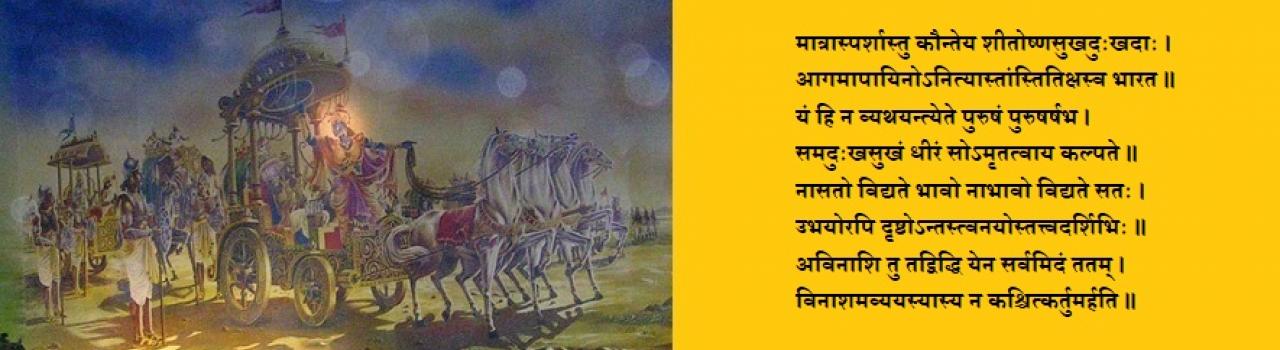
The sensory contact with the material objects gives the alternating experiences such as cold and heat, happiness and sorrow, which keep coming and going; they are indeed transitory. O Arjuna, do endure all of them.
Annotation
Bhagavān continues, “It should be clear to you, Arjuna, that the embodied Ātman (dehī) is eternal. Have you ever realized that the sensory experiences of the body are not permanent? They keep occurring and disappearing. The effect of those experiences on deha (the body) may be positive or negative. I have already mentioned to you that the body undergoes continuous changes, so the body is not permanent either. But human beings are excited about the positive or pleasant experiences, and upset about the unpleasant ones because they identify themselves with the body (deha).
“Dehī (the embodied), in contrast, stays quietly within us as an unaffected observer. You must know our true nature is dehī. Our goal is to be dehī. Therefore, do not be affected by what the body (deha) experiences, whether those experiences are pleasant or unpleasant. Learn to stay neutral at all times. To begin with, you may find it hard, but nothing is as worthy as transcending the dualities of the world,” Kṛshṇa reassures. [The dualities of the world are cold-heat, happiness-sorrow, pleasure-pain, and such opposites.]
Kṛshṇa asks Arjuna to endure all suffering and not to be excited about pleasurable experiences. He teaches in the Gita how one can experience that he/she is dehī, rather than the body. When one begins to live the experience of dehī, sufferings of the body (deha) will become inconsequential. In our analysis, to understand whether Arjuna’s temperament was spiritual, we discussed titikshā (as part of Sadhanā Chatushṭaya), an essential quality of a seeker. The endurance of the dualities Bhagavān speaks about points to titikshā. [To read about titikshā, click/tap on this link: Arjuna, the Disciple in the Bhagavad Gita]
[Earlier we saw in Brahma-tattva that Ātman (same as dehī) is unborn, deathless, changeless, all-pervading or omnipresent, all-powerful or omnipotent, and all-knowing or omniscient. But It cannot be perceived by our sense organs. So, it is important to remember that knowing Ātman is as an experience. To read Brahma-tattva, click/tap the link: Brahma-tattva ]
In the term mātrā-sparśaḥ (मात्रास्पर्शः), mātrā is the word that denotes the material world or matter. The word means that which is measurable. Thus, mātrā stands for all the finite objects (as perceived by the sense organs), which should be distinguished from the infinite Reality, Ātman or Brahman.
Elsewhere, we discussed the problem associated with constant sensory contact with the world and the countless objects with which our sense organs come into contact every day. As the sense organs come across the objects, they keep giving feedback to the mind. The mind, with the help of intellect, makes decisions that discriminate between the objects it likes and dislikes. Then the mind wants to own the objects of liking and avoid the others. In this process, the individual encounters many problems, and suffers internally from perpetual conflicts and confusions. If we gain what we wanted, we become happy, otherwise unhappy. If what we gained is stolen, again unhappy. When what we gained is exhausted and if we cannot replenish with fresh gains, we feel miserable. This continues incessantly. All these “unhappinesses”, small or big, accumulate in a person. The Indian medical system of Ayurveda says the accumulated “unhappinesses” and the consequent distress keep toxicity in the body at a high level, causing all ailments. That is greater suffering. When suffering becomes a daily affair, we do not recognize its smaller instances since we become used to them! We do not know what we miss, but suffering continues.
Here we are learning to live in genuine happiness.
Translation
That wise man who is unaffected by the sensory experiences stays even-minded in distress and happiness; O the noblest of men (Arjuna), he is indeed worthy of immortality.
Annotation
How motivating is the way Kṛshṇa encourages Arjuna! He says, “O the noblest of men, you too can become worthy of immortality; fight the obstacles. Among the obstacles in the path to śreyas are the sensory contact with the material objects and the resulting alternating pairs of experiences, such as happiness and distress. You cannot avoid the surge of those experiences. You should keep practising equipoise in the face of their onslaught. Remaining sama (सम, equal-minded) is the quality of the wise who know Truth.”
A secret we have heard from Bhagavān is that human beings can achieve immortality (अमृतत्व, amṛtatva). Brahma-vidya teaches how to experience our own true form (svarūpa), which is Ātman or dehī. Kṛshṇa exhorts Arjuna to strive to attain the experience of svarūpa and continue to live with that experience, for svarūpa or dehī has no birth or death, even when one discards the mortal body (deha).
Further, it is important to note that for all beings, their true form (svarūpa) is the same ̶ Ātman is only one. When we know that truth, it also means all beings, in essence, are one; and there are no reasons for humanity to stay divided with conflicting interests. The multiplicity we perceive in the world is part of the sensory experience Kṛshṇa is alluding to as an obstacle in the path of śreyas (the state of supreme merit); so, the multiplicity of interests among human beings must be an illusion ̶ a highly damaging illusion.
Translation
The unreal (asat) never manifests itself in different forms; from the Real (sat), the manifested forms have never been absent. What these two together conclude (express) is perceived by the seers of Truth.
Annotation
“Arjuna, you would have understood by now what I mean by real and unreal. Do not forget, Ātman alone is real. When Ātman is within the body, I call It dehī (the embodied). It is important to remember Ātman is not only inside the living beings but It fills everywhere outside as well. Ātman is the only real substance. Deha (the body) and the other things we perceive with our senses are unreal.
“You should now know that the real is sat. Do not be worried about these words. Sat means that which has true existence. We have already seen only Ātman or dehī is real, which means only Ātman has existence. All other things we perceive, including our body, appear in the world, seem to exist as individual entities for some duration, and then disappear. Those things that keep appearing and disappearing do not have existence, so they are not real. The unreal things that come and go, appear and disappear, are the manifested forms of sat. I call any manifested form a bhāva. A bhāva is unreal and has no existence, the opposite of sat, so it is asat (that which has no existence).
“Hey Arjuna, your yearning for the knowledge of Reality is singular. Therefore, I will explain the principle of Ātman with an everyday example; then you might easily grasp the doctrine I describe. Think of a few china dishes of different shapes, all made of clay ̶ a pot, a plate, a coffee mug and a tumbler. The material used to make all of them is clay. Each individual item has a different shape and utility (or function). However, when we use the coffee mug, we seldom realize it is a chunk of clay in reality. By accident, one of them, say a plate, falls from a height and breaks into many pieces. Now it can no more be called a plate. But if we collect the broken pieces, we still find the clay that was used to make the plate; the clay still exists. We thus conclude that clay is the true substance of the plate because it exists even when the plate is destroyed. The other dishes also have clay as their substance. They all have the same substance, but they appear in different shapes and sizes, with each one being of a different utility (function). This example will help you understand what I call sat and bhāva. Clay is the equivalent of sat and the different dishes are the various bhāvas of clay.
“Ātman, like the clay in our example, is the real substance sat, the essence of everything in the universe. All the individual entities we perceive in the universe ̶ human beings, the domestic and wild animals, the rocks, the mountains, the sun, the moon, etc. ̶ are the different bhāvas manifested by the same sat or Ātman.
“Arjuna, if we further analyze the example of clay and the dishes, it will reveal yet another important secret. Consider the shapes and utility of different dishes on one side and the material clay with which they are made of on the other; they both co-exist. We see a relation between the two. They are inseparably united. Thus is the relationship between Ātman (sat) and all the individual bodies or entities (bhāvas) we perceive in the universe. Inseparably united are sat and bhāva ̶ they are in yoga. That means a bhāva (a manifested form) cannot manifest other bhāvas. Why? The answer is, a bhāva has no existence, or it is asat (unreal), whereas sat (Ātman) never stays without Its manifested forms. For the seers, the combination of these two facts is part of their yogic vision of Truth.” [The word yoga is from the Sanskrit root yuj, means to join or unite].
“Arjuna, absorb the truth that the world (universe) has no existence other than that of Ātman or Brahman. [The word Brahman means that which expands and appears as the universe.] The world’s apparent existence is not its own, but is that of Reality (sat or Ātman). Sat or Ātman is eternal, so has always existed. While exists forever, Ātman also keeps manifesting forever as the world of infinite entities. The world of infinite entities is bhāva. Bhāva has no true existence, so I say it is asat. As told, in the world, we have sat and bhāva (Reality and non-Reality) always together. I explain to you in so many words because this doctrine is difficult for ordinary human beings to visualize.”
Kṛshṇa then summarizes, “An entity or a body visible in the world is asat, which cannot manifest itself in different forms because it is only a bhāva or the manifested form of sat; it is equally true that the eternal Reality (sat or Ātman) must always keep manifesting Itself in the different forms we perceive in the universe, no stopping. To comprehend Truth, one should be able to visualize these two together as part of the same Truth. The wise seers always see the two together (anayoḥ ubhayoḥ api antaḥ).” Bhagavān encourages his disciple, “My term for such wise seers is tattva darśibhiḥ (तत्त्व दर्शिभिः). Arjuna, meditating on the doctrine I have explained, you strive to become a seer of Truth.”
Bhagavān is pointing to the method of reasoning to reach (intuitively) Truth, which is beyond human reasoning. The method of reasoning is the tool of human beings. How can we overcome its limitations to find Reality that escapes reasoning? Formulate a new reasoning by the union of ‘what is’ and ‘what is not’ and meditate on it. It is yogic reasoning or buddhi-yoga.
[Notes: (1) We may use examples to illustrate a particular aspect of Ātman; but it is obvious we cannot find anything comparable with Ātman. The example of clay and the dishes only illustrates the common substance sat in all bhāvas. (2) We should not consider that the manifested bodies (bhāvas) are of no significance, although they are of no true existence as against Reality. In the transactional world, they are relevant. Let us understand that the human mind and intellect should not become the slaves of their favorite sense objects and the haters of the objects they dislike. The seeker of Truth should be the master who can withdraw the senses from all those objects at will and stay away from them as long as it is required. The human systemic error is in the glaringly inflated, incorrect value we attribute to sense pleasures.]
Translation
Know that One (That), which pervades everything in this universe, is imperishable. No one can cause the destruction of this Immutable.
Annotation
Kṛshṇa advises further on the immortality of sat or Ātman, “Let me tell you something more about sat. I have explained to you that sat is visible to us only as its bhāva (the manifest world). Everything we perceive is Its manifestation. Therefore, you should know sat or Ātman is the primal cause of everything in the world. You and I are no exceptions. If sat is the primal cause, all Its manifested forms have to be Its effect. Although invisible, Ātman fills everything and everywhere with Itself and is present everywhere as the cause of the Universe. Where Ātman is present, you will see the universe, the effect, too. That sat or Ātman is imperishable (avināśi), never withers away on Its own; nor can It be destroyed by anyone, because other than sat everything else is Its effect. Can a shadow kill its cause, the light?
“The wise seers live in oneness with the indestructible sat or Ātman or dehī, which remains immutable even after deha (the body) is discarded. That explains what immortality is. For this reason, I advise you to become a seer of Truth, for you will then be immortal. Of course, a formidable challenge is to become a seer of Truth; never give up, Arjuna, for you have my wholehearted support.” Kṛshṇa, the embodiment of compassion, reassures his disciple.
Let us look at a corollary of the Advaita or non-duality doctrine that we, the Gita students, should understand. We learn Ātman or Brahman or sat is the primal cause of the universe. The universe is the bhāva (manifestation) of sat. In the transactional world, we practice a concept of ownership or belongingness. To whom does the universe belong? Everything we perceive as things appearing and disappearing in the world is only the bhāva (manifestation) of sat or Ātman. If there is an owner for everything in the world, it has to be only Ātman! No one else can create Its bhāva. By that rule, no one else should destruct Its bhāva either. Remember, our bodies are also Its bhāva. Has anyone the right to harm the bodies of any living being? Obviously, no. It is the ahimsa (non-hurting or non-killing) principle inherent in Vedanta philosophy.
--------------------
(To read the next post [Gita Post #18], click/tap on this link: https://www.ekatma.org/node/197)
Leave a comment